
Float Review 2026: Cash Flow Forecasting From $105 a Month
What Float's Small Business, Growth and Scale plans cost a year, how the revenue line and entity count pick your plan, and four cash flow alternatives with their prices.

Float is worth it for a company on Xero or QuickBooks Online that wants a ready-made 13-week cash forecast without building one in a spreadsheet. On Float's US pricing, read on October 21, 2026, Small Business costs $105 a month billed annually or $130 monthly, Growth $215 or $265, and Scale $315 or $389, all excluding tax.
The plan is picked by your revenue, not your preference. Companies under £2 million in revenue, measured from the last full financial year in the connected ledger, get Small Business; larger companies start at Growth. Anyone on NetSuite, Sage Intacct or another ledger cannot connect today.
Key factsBest for: Xero and QuickBooks Online companies that want a ready-made…
- Forecasting-first software that turns ledger data into rolling cash views and scenarios, priced by revenue and entities.
- Entry plan: Small Business, for companies under £2 million in revenue
- Ledgers supported: Xero and QuickBooks Online only
- Users: Unlimited on every plan, with Admin, Editor and Viewer roles
- Free trial: 14 days, no credit card required
Pros
- Unlimited users on every plan, so the whole leadership team can view the forecast at no extra cost.
- Eight scenarios and a 13-week rolling view on every plan, including Small Business.
- Scale consolidates up to five entities with currency conversion before per-entity fees start.
Cons
- Connects only to Xero and QuickBooks Online; Sage Intacct and iplicit are still waitlists.
- Plan is set by revenue above or below £2 million, so a growing company is moved up a tier.
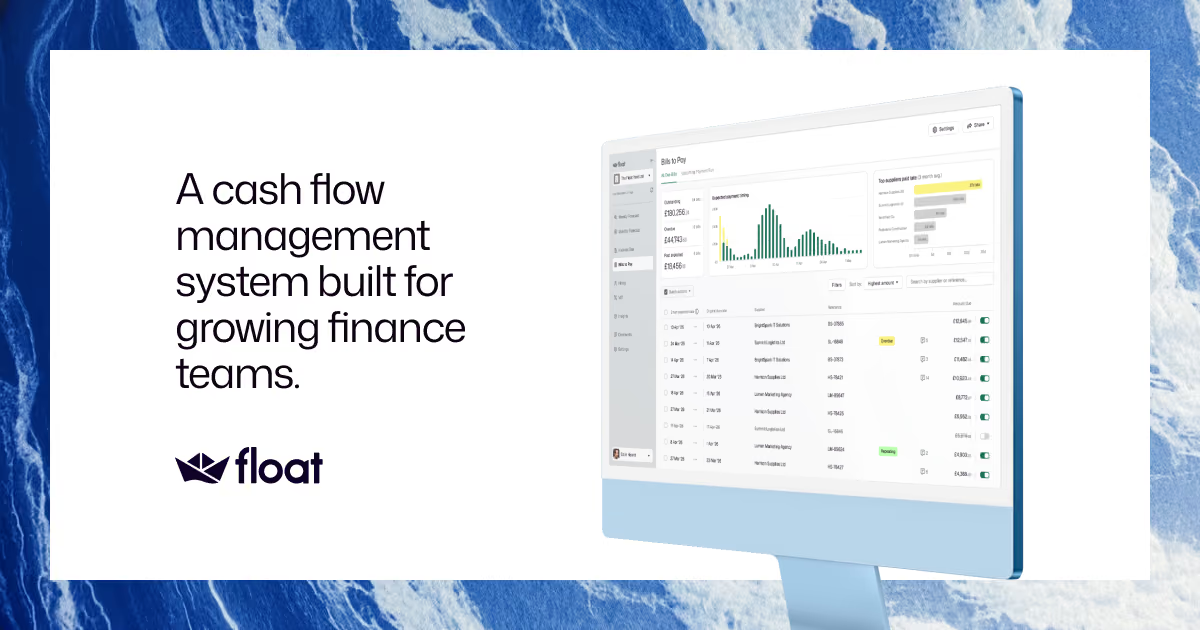
Float is cash flow forecasting software that reads actuals and open invoices from Xero or QuickBooks Online and turns them into a rolling forecast with scenarios. It sits between a spreadsheet model and a full FP&A platform, and it is the first pick in our best cash flow forecasting tools ranking.
This review is for a controller, fractional CFO or founder deciding whether Float's fee beats maintaining a 13-week model by hand. It covers what each plan costs on monthly and annual billing, how revenue and entity count decide the bill, what the integrations rule out, and which tools to compare. Prices and features come from Float's pricing page and small business pricing page, read on October 21, 2026. CFOpresso does not test products hands-on, so forecast accuracy is not rated here.
Toolradar data: Float is listed as an alternative to 37 other tools in the catalog of Toolradar, the software directory we run, joint 17th of 633 finance tools, and only 31% of those finance tools offer a free plan, as of October 2026. Float has none, so the 14-day trial is the only no-cost way in.
What is Float?
Float connects to one accounting ledger per company, pulls bills, invoices and bank balances, and projects cash forward on two horizons: a 13-week rolling view for weekly decisions and a monthly view that reaches 12 months on Small Business and 36 months on Growth and Scale. Eight scenarios on every plan let a finance team model a hire, a lost customer or a funding delay against the base case.
It is a cash forecasting tool rather than a full budgeting or FP&A suite, and it has no ledger connector beyond Xero and QuickBooks Online, though Float says direct Sage Intacct and iplicit connections are in development with waitlists open.
How Float works
Revenue sets the plan. Float takes revenue from the accounting platform when a company connects, using the most recent full financial year report. Under £2 million puts you on Small Business; over it, Growth or Scale. A US company crossing that line moves up a tier whether or not it needs the extra features, so budget for Growth a year before revenue gets there.
Entities set the Scale bill. Growth covers a single entity. Scale adds multi-entity consolidation, with currency conversion across companies, for up to five entities, and each entity beyond five costs $63 a month on annual billing or $78 monthly, per the pricing page.
Users are not metered. Every plan includes unlimited users with three roles, Admin, Editor and Viewer, so sharing the forecast with a CEO or lender adds nothing to the bill. Two-factor authentication is mandatory for Xero users, and single sign-on through the accounting platform covers the initial user.
Float key features
Float pricing
Float's pricing page and small business page, read in US dollars on October 21, 2026, list three self-serve plans, excluding VAT and sales tax. Float advertises a 20% saving for annual billing on every plan.
A year of Float costs $1,260 to $3,780 on annual billing. Twelve months of Small Business at the annual rate is $1,260, against $1,560 paid monthly; Growth is $2,580 against $3,180; Scale is $3,780 against $4,668, our arithmetic on the printed monthly figures. Float will invoice annually for bank transfer, while most customers pay monthly by card.
Entities push Scale up fast. A group with seven entities on Scale pays for two entities beyond the included five: $441 a month on annual billing, or $5,292 a year, our arithmetic. On monthly billing the same group pays $545 a month.
Against rivals, Float is mid-priced. Pulse sells its basic plan at $29 a month and Fathom's Pro plan starts at $59 a month for one company, while Agicap prints no price and requires a 12-month contract. Float costs more than Pulse or Fathom, and buys a forecasting-first product built around the 13-week view.
| Plan | Price | Best for |
|---|---|---|
| Small Business | $105/mo billed annually, or $130 monthly | Companies under £2 million in revenue; one company, unlimited users, 8 scenarios, 13-week view, 12-month forecasts |
| Growth | $215/mo billed annually, or $265 monthly | Companies over £2 million in revenue; single entity, 36-month forecasts, onboarding call, email and live-chat support |
| Scale | $315/mo billed annually, or $389 monthly | Everything in Growth plus multi-entity consolidation for up to 5 entities, priority support and a named contact |
| Scale, extra entities | $63/entity/mo billed annually, or $78 monthly | Each entity beyond the five included in Scale |
Float pros and cons
What we like
- Unlimited users on every plan, so the whole leadership team can view the forecast at no extra cost.
- Eight scenarios and a 13-week rolling view on every plan, including Small Business.
- Scale consolidates up to five entities with currency conversion before per-entity fees start.
What could be better
- Connects only to Xero and QuickBooks Online; Sage Intacct and iplicit are still waitlists.
- Plan is set by revenue above or below £2 million, so a growing company is moved up a tier.
Who Float is for
Float fits a finance team of one to five people at a company on Xero or QuickBooks Online that reviews cash weekly and reports to a board or lender monthly. Fractional CFOs running several clients, and groups with a handful of entities in different currencies, get the most from Scale's consolidation.
Skip Float if your ledger is NetSuite, Sage Intacct or Business Central, because it cannot connect today; the FP&A software pricing comparison covers tools that do. Skip it too if cash is predictable enough that a spreadsheet works: our 13-week cash flow forecast guide shows how to build one for free.
Best Float alternatives
If Float is not the right fit, these are the closest options.
| Tool | Best for | Starts at | |
|---|---|---|---|
| Float | Xero and QuickBooks Online companies that want a ready-made 13-week and 36-month cash forecast | Small Business from $1,260/yr billed annually | Visit → |
| Pulse | Small business owners who want a simple cash calendar more than a finance-team forecast | Basics from $29/mo | Visit → |
| Fathom | Accountants and finance leads who need management reporting plus three-way forecasting | Pro from $59/mo for one company | Visit → |
| Agicap | Mid-size companies that want cash forecasting and collections in one platform | Quote-only | Visit → |
| Cash Flow Frog | Small companies on ledgers Float does not support, such as Zoho Books, FreshBooks or Odoo | Priced by annual revenue through the calculator on its pricing page | Visit → |


The bottom line
Float is the right buy for a Xero or QuickBooks Online company that needs a weekly cash forecast it can trust, and Small Business on annual billing is the cheapest way in. Growth earns its higher price through the 36-month view and included onboarding; Scale earns it only for groups with several entities. Run the 14-day trial on real data before paying, because the fit depends on how clean your ledger is.
Compare it with the field in best cash flow forecasting tools and, for a first finance hire's stack, best tools for a first finance hire. Ledger choice comes first: see the Xero review, the QuickBooks Online review and Xero vs QuickBooks Online. Toolradar keeps a profile of Float and of Fathom; for planning beyond cash, see best FP&A software for SaaS.
Methodology: prices and features were read on October 21, 2026 on Float's two pricing pages and FAQ, and on the pricing pages of Pulse, Fathom, Agicap and Cash Flow Frog. Yearly and entity totals are our arithmetic on printed prices, before tax. No rating on this page is our own.
This page is general information, not personalized financial advice. Confirm current pricing, plan eligibility and integrations with Float and each provider before you sign.
Cite this: CFOpresso, 'Float Review 2026', November 2026.
Frequently asked questions
Is Float worth it for cash flow forecasting in 2026?
How much does Float cost?
Which Float plan do I need?
Does Float integrate with NetSuite or Sage Intacct?
Does Float have a free trial?
Sources
Prices and plan details come from each vendor's own pricing page, re-checked by the Toolradar pricing tracker.
- Fathom pricingchecked Sep 2026
Some offers on this page may be paid placements or contain affiliate links.
More CFOpresso reviews
Buyer guides and software reviews, with prices read from each vendor's own pricing page.
Browse all reviews