
Digits Review 2026: AI Accounting Pricing, Pros and Cons
What each Digits plan costs a year, the payment and entity fees outside the plan price, and when Puzzle, QuickBooks, Xero or Pilot fits better.

Digits is a good AI-native ledger in 2026 for a US startup that wants software to keep its books and a price it can read before talking to sales. Essentials costs $65 a month, Core $100 a month and Pro $250 a month, with Pro still marked coming soon, read on Digits' pricing page on November 4, 2026. Every plan starts with a 30-day free trial and no setup fee.
The limits are just as clear. Digits serves only US-based entities, files no tax returns, and includes no human bookkeeper in the plan price. A finance lead who wants someone else to own the close should price Pilot or Puzzle's managed tier instead.
Key factsBest for: US startups and small businesses that want an AI-maintained…
- An AI-native general ledger that books and reconciles around the clock, sold on three printed monthly plans.
- Plans: Three monthly plans, Essentials, Core and Pro (coming soon)
- Core for a year: $1,200 at the monthly list price, our arithmetic
- Free trial: 30 days on every plan, with no setup fee
- Coverage: US-based entities only
Pros
- Every plan price is printed, with a 30-day free trial and no setup or migration fee
- Automated accrual schedules and department tracking arrive on the Core plan
- Extra entities are free up to 250 transactions a year, then from $35 a month each
Cons
- Serves US-based entities only, so a foreign subsidiary needs another ledger
- No consolidated reporting in the product; group financials run through Reach Reporting
- Budget vs. actuals waits for Pro, which is not yet available to buy
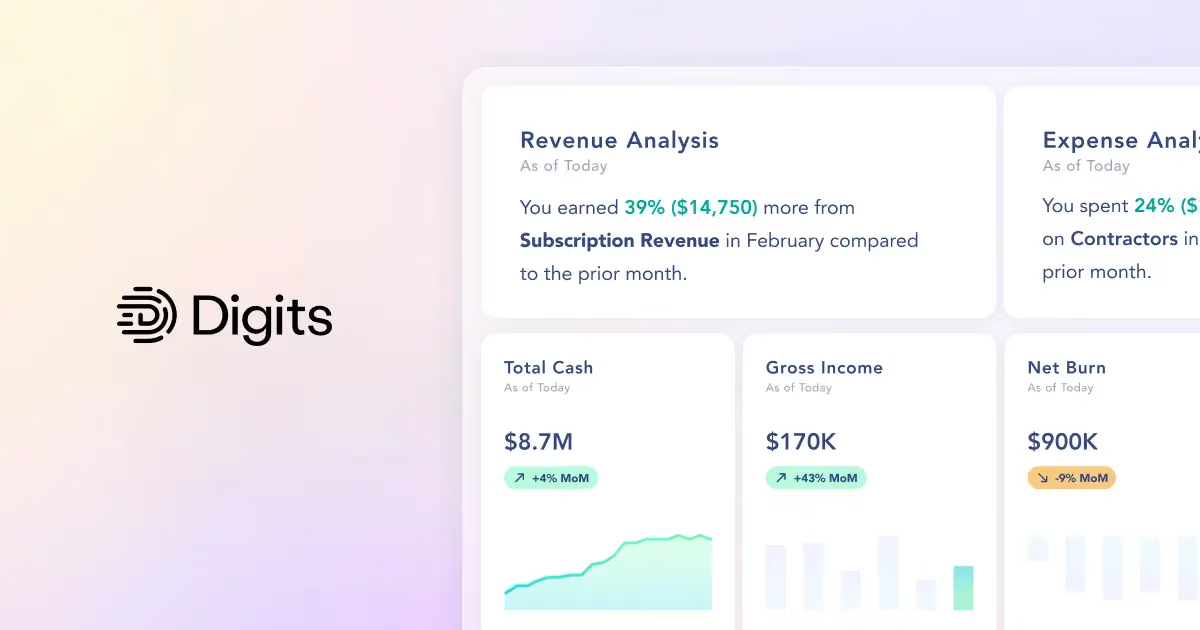
Digits sells an accounting ledger that an AI keeps current around the clock: it pulls activity from banks, cards and payroll, categorizes and reconciles it, and produces statements from the live ledger. For a CFO or a first finance hire, the useful questions are narrower than the marketing. What does a year of Digits cost once entities and payment fees are added, which controls sit behind the Core and Pro paywalls, and how does it compare with the ledger you already know?
CFOpresso data: Toolradar, the software directory we run, evaluates 290 accounting tools on its accounting software ranking (read November 4, 2026). QuickBooks is listed as an alternative to 103 of them, more than any other accounting product. That is the incumbent Digits has to displace, so this review prices it against QuickBooks Online first. The Digits profile on Toolradar carries its listed alternatives.
What is Digits?
Digits is AI-native accounting software for US small businesses and the accounting firms that serve them. Its pricing page lists a general ledger with drill-down from category to transaction, 24/7 AI bookkeeping and reconciliation, and live profit and loss, balance sheet and cash flow statements. Bill pay, invoicing, a document vault and a developer API with an MCP connection come on every plan. Ask Digits, an AI financial assistant, answers questions on the books, and native apps cover iPhone and iPad.
Digits supports both cash and accrual accounting and says it is SOC 2 Type II certified. It does not file taxes: it exports a tax package for your preparer or points you to a partner firm. That makes it a ledger replacement, not an outsourced finance function. If you are still deciding between software and a bookkeeping service, our guide to what bookkeeping costs a startup frames that choice, and our AI accounting software ranking places Digits among its peers.
How Digits works
Digits connects to more than 12,000 banks, cards and payroll providers, imports activity as it happens and books each transaction with its own AI models. Reconciliation runs continuously against the connected accounts, and exceptions surface as they occur rather than at month-end. A checklist groups the close into book, reconcile and report steps, and an AI Quality Review flags errors and inconsistencies.
Plan level decides how much accrual work is automated. Dimensional accounting, for department and location tracking, and automated schedules for accruals and amortization start on Core. Budget vs. actuals and custom reports and dashboards are Pro features, although partner accounting firms get custom reports on lower plans. On November 3, 2026 Digits rebuilt its Stripe integration so revenue is booked when invoiced and payments clear receivables, according to the Digits changelog. For a SaaS company that bills through Stripe, that removes much of the manual revenue matching at close.
Multi-entity groups get one login with a separate ledger per entity. Consolidated reporting is not built in: Digits routes it through a partnership with Reach Reporting, which our Reach Reporting review prices on its own.
Digits key features
Digits pricing
Digits prints its prices in US dollars as monthly amounts, and every figure here was verified on November 4, 2026 on Digits' pricing page: Essentials $65 a month, Core $100 a month and Pro $250 a month, marked coming soon. Its structured data lists the same three prices on a one-month billing term. The plan prices have held since at least June 2025, when an archived copy of the pricing page showed Essentials and Core at today's prices, with Essentials then marked coming soon.
Yearly cost scenarios, our arithmetic on those list prices: a solo founder on Essentials pays $780 a year. A seed-stage company on Core pays $1,200. A holding company with two subsidiaries that each pass 250 transactions a year pays at least $2,040 on Core, because each extra entity starts at $35 a month. A Series A team waiting for budget vs. actuals would pay $3,000 a year on Pro once it launches. Before the October 27, 2026 multi-entity release, the March 2026 pricing page sold multi-entity only on a custom-priced Advanced tier.
Fees outside the plan price come from the Digits Pay fee schedule. Card payments on invoices cost 2.9% plus 30 cents, so a $10,000 invoice paid by card costs the sender $290.30. ACH collections cost 1%, capped at $15 on Essentials and $10 on Core. Bill pay costs 50 cents per ACH payment and $2.50 per mailed check, so 40 ACH payments a month add $240 a year. Sales tax may also apply to the subscription depending on your location.
Methodology: Digits prices, features and fees come from its pricing page, help center and changelog, read November 4, 2026. Alternative prices come from Puzzle's pricing page, QuickBooks Online pricing, Xero's US pricing page and Pilot's pricing page, read the same day. Yearly totals and fee examples are our arithmetic; nothing here comes from a trial account.
| Plan | Price | Best for |
|---|---|---|
| Essentials | $65/mo | AI bookkeeping and reconciliation, live statements, bill pay, invoicing, API and MCP, multi-entity |
| Core | $100/mo | Everything in Essentials plus dimensional accounting and automated accrual schedules |
| Pro (coming soon) | $250/mo | Everything in Core plus budget vs. actuals, custom reports and custom dashboards |
| Additional entity | Free, then from $35/mo | Free up to 250 transactions a year per extra entity, with its own ledger and close |
| Card payments on invoices | 2.9% + 30 cents | Applies to credit, debit, Apple Pay and Google Pay; international cards add 1.5% |
| ACH collections | 1%, capped | Cap of $15 per payment on Essentials and $10 on Core; returns cost $7.50 |
Digits pros and cons
What we like
- Every plan price is printed, with a 30-day free trial and no setup or migration fee
- Automated accrual schedules and department tracking arrive on the Core plan
- Extra entities are free up to 250 transactions a year, then from $35 a month each
What could be better
- Serves US-based entities only, so a foreign subsidiary needs another ledger
- No consolidated reporting in the product; group financials run through Reach Reporting
- Budget vs. actuals waits for Pro, which is not yet available to buy
Who Digits is for
Digits suits a US startup or small business with one to a few entities that wants software, not a firm, to keep the books, and a finance lead or outside accountant to review them. Core is the plan most growing companies will need, because accrual schedules and department tracking are where the AI saves real close time. A company already on QuickBooks should compare Digits Core with QuickBooks Plus at list price, which our QuickBooks Online review breaks down tier by tier.
Skip Digits if any entity sits outside the US, if you need consolidated group statements inside the ledger, or if nobody on the team will own the review. For groups, our multi-entity accounting guide and our Rillet review cover tools built for consolidation. If you would rather buy the close than run it, our Puzzle review prices its managed tier, and our close management software ranking covers what a controller adds on top of the ledger. A first finance hire can use Digits as the system of record from day one.
Best Digits alternatives
If Digits is not the right fit, these are the closest options.
| Tool | Best for | Starts at | |
|---|---|---|---|
| Digits | US startups and small businesses that want an AI-maintained ledger with a printed price and no bookkeeper | Essentials $65/mo, Core $100/mo, Pro $250/mo (coming soon) | Visit → |
| Puzzle | Startups that want an AI ledger plus an optional managed bookkeeping tier | Starter $30/mo, Core $72/mo, Complete $120/mo billed monthly | Visit → |
| QuickBooks Online | Businesses whose accountant, payroll and app stack already assume QuickBooks | Simple Start $38, Essentials $85, Plus $140, Advanced $340 a month at | Visit → |
| Xero | Small businesses that want a low-cost cloud ledger with sales tax and 1099 tools included | Early $27, Growing $59, Established $97 a month at list | Visit → |
| Pilot | Founders who want a provider to close the books, with tax filing available from the same firm | Bookkeeping Essentials $99/mo for up to $100,000 in monthly expenses | Visit → |


The bottom line
Digits is a good AI-native accounting platform for US startups that want the books kept by software at a printed price, and Core is the plan to start on. Use the 30-day trial to connect your real bank, card and payroll accounts and check how much of a month the AI books correctly before you commit. Budget for payment fees if you will invoice and pay bills through Digits.
Look elsewhere if you need a person to own the close, built-in consolidation, or a ledger for entities outside the US. Pilot fits the first case, Rillet the second, and a ledger that serves your other countries the third. Our AI accounting software ranking lines up the full field.
Cite this: CFOpresso, "Digits Review 2026: AI Accounting Pricing, Pros and Cons", November 2026.
Frequently asked questions
How much does Digits cost?
Is Digits a good AI accounting platform in 2026?
Does Digits have a free trial?
Does Digits do my taxes?
What are the hidden costs of Digits?
Digits vs QuickBooks Online: which costs less?
Sources
Prices and plan details come from each vendor's own pricing page, re-checked by the Toolradar pricing tracker.
- Digits pricingchecked Sep 2026
- Puzzle pricingchecked Sep 2026
- QuickBooks Online pricingchecked Sep 2026
- Xero pricingchecked Sep 2026
- Pilot pricingchecked Sep 2026
Some offers on this page may be paid placements or contain affiliate links.
More CFOpresso reviews
Buyer guides and software reviews, with prices read from each vendor's own pricing page.
Browse all reviews