
Reach Reporting Review 2026: Pricing, Dashboards, Pros and Cons
What Reach costs per connected company on monthly and annual billing, what every plan includes, and when Fathom, Jirav or Datarails fits better.

Reach Reporting is worth it for accounting firms and fractional CFOs reporting on 10 or more client companies. It costs $149 a month for one connected company, $290 a month for 10 and $550 a month for 25, read on Reach's pricing page on November 4, 2026, with every feature and unlimited users on every plan. Annual billing is where it wins: 10 companies cost $2,436 a year, which on our arithmetic is $1,344 less than 12 months of Fathom Pro at the same count. For a single company, Fathom's $59 entry tier costs far less.
Key factsBest for: Accounting firms and fractional CFOs reporting, forecasting…
- Connection-priced reporting, three-way forecasting and consolidation with every feature and unlimited users on every plan.
- 10 companies, annual: $2,436 a year
- Users: Unlimited on every plan
- Free trial: 30 days, no credit card
- Alternatives covered: Fathom, Jirav, Datarails, Spotlight Reporting
Pros
- All features and unlimited users on every plan, so cost moves only with connected companies.
- The 10-connection package costs less per month than two single connections.
- 30-day free trial with no credit card, longer than Fathom's 14 days.
Cons
- A single company costs far more than on Fathom Pro's single-company tier.
- No refunds for unused billing cycles, and mid-cycle additions are billed prorated on the next invoice.
- White label needs a one-time $2,500 setup fee on top of the subscription.
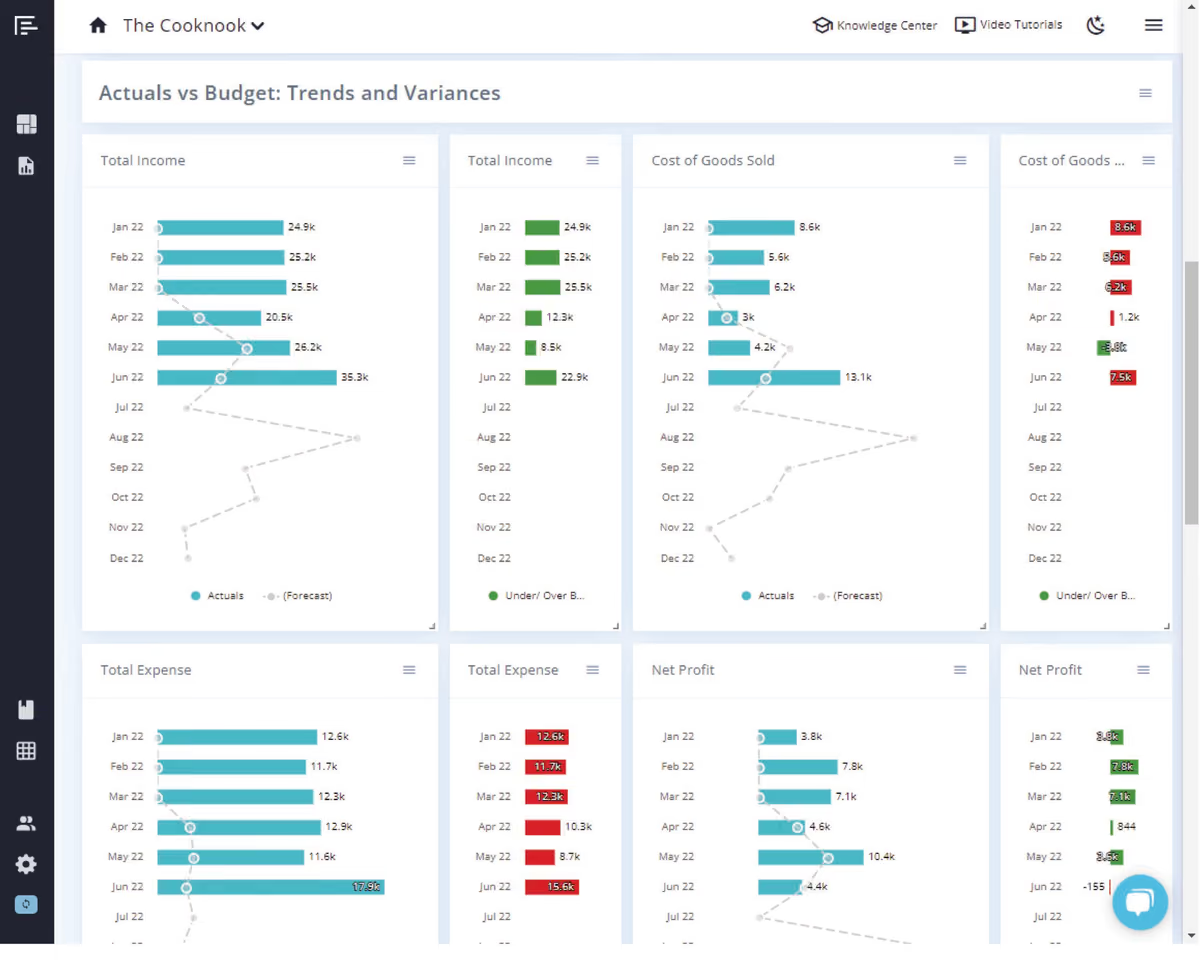
Reach Reporting sells one thing to finance teams and advisory firms: management reports, dashboards, forecasts and consolidations built on top of QuickBooks, Xero and a few other ledgers, priced by the number of companies you connect.
There are no feature tiers. A one-company plan gets the same consolidation, three-way forecasting and client portal as a 25-company plan, so the only real buying decision is how many companies you will connect and whether you can commit for a year.
This review is written for controllers, fractional CFOs and CAS practice leads deciding whether Reach is worth its connection fee. It covers the price ladder on monthly and annual billing, a cost model against Fathom at 1, 10 and 25 companies, the fees that sit outside the list price, and the cases where another tool is the better buy. We read vendor pages only and did not run the software ourselves.
What is Reach Reporting?
Reach Reporting is a cloud financial reporting and FP&A tool that connects to an accounting ledger, then builds branded monthly reports, KPI dashboards, budgets, three-way forecasts and multi-entity consolidations from that data.
Its supported integrations are QuickBooks Online, QuickBooks Desktop, Digits, Xero, MYOB, Gusto, Google Sheets, Microsoft Excel and a CSV trial balance upload, all with read-only access to the books.
Toolradar data: Toolradar, the software directory we run, tracks 20 financial planning tools as of November 3, 2026, and only 1 of the 10 it ranks publishes a paid price. Reach printing its full ladder on its own page is therefore unusual in this corner of finance software, and it lets a firm model its cost before talking to sales.
The product sits between a pure reporting layer such as Fathom and a full FP&A suite such as Datarails. It is built for people who send the same reporting pack to many companies every month, not for an FP&A team modelling one complex business.
How Reach Reporting works
You connect a ledger, and Reach pulls the trial balance and keeps it synced. The closed month rolls forward on its own, so the reports and dashboards you built last month refresh with the new period rather than being rebuilt. For a firm sending 25 monthly packs, that roll-forward is where most of the time saving comes from.
Reports are assembled from a template library or built in what Reach calls an intelligent spreadsheet, so a controller used to Excel logic can define custom metrics and statements without learning a new formula language. AI features draft variance commentary, suggest business-specific KPIs and flag anomalies.
Treat that commentary as a first draft that a reviewer signs off, because a client reads it as your firm's view.
Consolidation handles multiple entities and currencies. Reach matches accounts with the same name or category across companies, zeroes out accounts you mark for intercompany elimination, converts to a common reporting currency at historical rates and lets you manage translation differences with custom rows.
Drill-down runs from the consolidated view to each company, filtered by class, department or location.
Delivery happens through live share links or the client portal. Clients get role-based, view-only or edit access to folders of reports, dashboards and uploaded files such as PDFs and Excel workbooks. Users are unlimited on every plan, so adding a client's bookkeeper or a board member costs nothing extra.
Reach Reporting key features
Reach Reporting pricing
Reach's pricing page, read on November 4, 2026, prices by connected company and includes every feature on every plan. On monthly billing, one connection is $149, and each added connection at that level costs the same again.
The 10-connection package is $290 a month, with extra connections at $29 each, and the 25-connection package is $550 a month, with extras at $22. Annual billing costs $1,548 a year for one connection, $2,436 for 10 and $4,620 for 25, which the page shows as savings of $240, $1,044 and $1,980 against monthly billing.
Package math changes the decision for small firms. On our arithmetic, two single connections cost $298 a month, more than the whole 10-connection package. Any firm with two or more companies should start on the 10-pack.
Per company, annual billing works out to about $20 a month at 10 connections and about $15 at 25.
Against Fathom's published USD prices, read the same day, the result depends on count. One company costs $59 a month on Fathom Pro, $708 a year at 12 months (our arithmetic), against $1,548 on Reach's annual plan.
At 10 companies Fathom is $315 a month, or $3,780 for 12 months, so Reach's annual package costs $1,344 less. At 25 companies Fathom is $450 a month, or $5,400 for 12 months, against $4,620 on Reach annual, a $780 gap. On month-to-month billing at 25, Fathom is the cheaper of the two by $100 a month.
Three terms sit outside the list price. White labeling carries a one-time $2,500 setup fee, per Reach's knowledge center. There are no refunds for unused billing cycles, monthly or annual.
Companies added mid-cycle are billed prorated, so a monthly invoice can run higher than the package price. The free trial lasts 30 days and needs no credit card.
| Plan | Price | Best for |
|---|---|---|
| 1 Connection | $149/mo, or $1,548 a year billed annually | One connected company, all features, unlimited users; extra connections $149 each |
| 10 Connections | $290/mo, or $2,436 a year billed annually | Ten connected companies, all features, unlimited users; extra connections $29 each |
| 25 Connections | $550/mo, or $4,620 a year billed annually | Twenty-five connected companies, all features, unlimited users; extra connections $22 each |
| Custom volume packages | Contact sales | Discounted packages with minimums such as 50 connected companies |
| White label add-on | $2,500 one-time setup | Your logo, favicon and URL replace Reach Reporting branding |
Reach Reporting pros and cons
What we like
- All features and unlimited users on every plan, so cost moves only with connected companies.
- The 10-connection package costs less per month than two single connections.
- 30-day free trial with no credit card, longer than Fathom's 14 days.
What could be better
- A single company costs far more than on Fathom Pro's single-company tier.
- No refunds for unused billing cycles, and mid-cycle additions are billed prorated on the next invoice.
- White label needs a one-time $2,500 setup fee on top of the subscription.
Who Reach Reporting is for
Reach fits accounting firms, CAS practices and fractional CFOs who send monthly reporting packs to 10 or more client companies and want consolidation and forecasting in the same tool.
It also suits a multi-entity business, a franchise group or a nonprofit with several entities that needs consolidated reporting with eliminations and wants to give its board live dashboards instead of PDFs.
For a broader shortlist, see our board reporting software guide and financial consolidation tools ranking.
It is a weaker fit in three cases. A single business with one ledger pays more on Reach than on Fathom's entry tier, as our Fathom HQ review sets out.
A mid-market FP&A team that lives in Excel and needs driver-based planning across ERPs should read our Datarails review and the FP&A software pricing comparison.
A firm on NetSuite or Sage Intacct should check the integration list first, because Reach's supported sources stop at QuickBooks, Xero, Digits, MYOB, Gusto and spreadsheet uploads.
If cash forecasting is your main job rather than reporting, compare the cash flow forecasting tools list and our guide on building a 13-week cash flow forecast.
Toolradar also keeps its own pages for Fathom HQ, Jirav and Datarails.
Best Reach Reporting alternatives
If Reach Reporting is not the right fit, these are the closest options.
| Tool | Best for | Starts at | |
|---|---|---|---|
| Reach Reporting | Accounting firms and fractional CFOs reporting, forecasting and consolidating for 10 or more client companies. | $149/mo for 1 company, $290/mo for 10, $550/mo for 25 | Visit → |
| Fathom | Single businesses and firms that want management reports, KPIs and benchmarking on month-to-month billing. | Fathom Pro from $59/mo for 1 company | Visit → |
| Jirav | CFO advisory firms selling budgeting, workforce planning and scenario models as a service. | Firm plans from $50/mo (Controller Essentials) or $150/mo (CFO Enterpr | Visit → |
| Datarails | Mid-market finance teams that want to keep Excel and add consolidation, planning and close. | Quote-only | Visit → |
| Spotlight Reporting | Advisory firms and franchise groups that want reporting, forecasting and group-wide benchmarking. | Check the current price on Spotlight Reporting's site | Visit → |


The bottom line
Reach Reporting is worth it once you report on several companies and can commit to a year. The 10-connection annual plan is the sweet spot: every feature, unlimited users and a lower 12-month bill than Fathom at the same count.
For a single company, the economics flip, and Fathom's entry tier is the cheaper way to get branded reports and forecasts.
Skip it if you run one company on NetSuite or Sage Intacct, or need enterprise FP&A modelling. Its integrations stop at small-business ledgers and spreadsheets, and it has no refunds on unused cycles, so use the 30-day trial to build one real client pack before paying.
Firms comparing several tools can use our CFO software pricing index and the AI financial reporting tools list.
Methodology: prices and terms come from Reach's pricing page, feature pages and knowledge center, Fathom's and Jirav's pricing pages and Datarails' plan page, all read on November 4, 2026, plus the Toolradar category count. Annual and 12-month totals are our arithmetic on printed prices.
We did not use the software. Cite this: CFOpresso, 'Reach Reporting Review 2026: Pricing, Dashboards, Pros and Cons', November 2026.
Frequently asked questions
How much does Reach Reporting cost in 2026?
Is Reach Reporting cheaper than Fathom?
Does Reach Reporting have a free trial?
What does Reach Reporting integrate with?
Can I white label Reach Reporting?
Sources
Prices and plan details come from each vendor's own pricing page, re-checked by the Toolradar pricing tracker.
- Fathom pricingchecked Sep 2026
- Datarails pricingchecked Sep 2026
Some offers on this page may be paid placements or contain affiliate links.
More CFOpresso reviews
Buyer guides and software reviews, with prices read from each vendor's own pricing page.
Browse all reviews