
Payhawk Review 2026: Cards, AP and Expenses Pricing, Pros and Cons
What each Payhawk module costs in the US, which features are add-ons, what its Visa card charges on foreign spend, and when Ramp, Brex, Pleo or Navan costs less.

Payhawk is a good spend management platform in 2026 for a mid-sized company with entities in the US, UK and Europe that wants cards, bills, purchasing and travel on one ledger-connected system. It is a poor buy for a small domestic team. Cards & Expenses starts at $449 a month, read on Payhawk's US pricing page on November 4, 2026.
Each module carries a flat monthly entry price with unlimited employee seats, so the math favours headcount: past roughly 33 cardholders, that module costs less than Pleo Build on monthly billing. The all-in Payhawk Complete bundle, the NetSuite and Sage Intacct connectors and extra entities are quote-only.
A US team that will run spend on one card should price Ramp or Brex first, because both have a free plan.
Key factsBest for: Multi-entity companies in the US, UK and Europe that want…
- Modular spend platform with Visa cards issued locally in each region, flat monthly module fees and a quote-only bundle.
- US modules: Travel, Cards & Expenses, Accounts Payable, Procurement
- Employee seats: Unlimited in every module
- US Visa card FX fee: 2.99% on transactions in another currency
- Alternatives covered: Ramp, Brex, Pleo, Navan
Pros
- Every module includes unlimited employee seats, card transactions and document processing.
- Link & Control syncs existing Visa, Mastercard and Amex cards, so a bank card program can stay.
- No implementation fee, and 50+ HRIS integrations and SSO are included in every module.
Cons
- Even the cheapest module is a high monthly floor for a small team with few cardholders.
- NetSuite, Sage Intacct and Business Central connectors, budgets and extra entities are paid add-ons.
- Its US Visa card lists a higher foreign-exchange rate than Pleo charges on Build.
Buy Payhawk when the finance team closes several entities across currencies and wants one approval engine for cards, supplier bills and purchase orders. That is the company its pricing is built for: flat module fees, no per-employee charge, and no implementation fee.
Skip it when the company has fewer than about 30 people spending money, or when every dollar is spent in the US. A flat monthly floor is expensive for a small team, and the US card platforms give their expense software away.
Toolradar data: Toolradar, the software directory we run, tracks 90 expense management tools as of November 4, 2026, with a median cheapest paid plan of $12 a month across the 47 that publish a price. The Payhawk profile ranks its cheapest module 34th of 34 on price among tools priced on the same basis, which says who Payhawk is for more plainly than any feature list.
How we compared: Payhawk's US pricing page, its US card fee schedule, its corporate card and card-linking pages, and the Ramp, Brex, Pleo and Navan pricing pages, all read on November 4, 2026. No product was run hands-on; every claim comes from those vendor pages.
What is Payhawk?
Payhawk is spend management software that combines corporate cards, expense reports, accounts payable, procurement and business travel. It is led by co-founders Hristo Borisov (CEO), Konstantin Dzhengozov (CFO) and Boyko Karadzhov (CTO), has its registered office in London, and runs a US office at 1245 Broadway in New York.
The product is built for cross-border groups. Payhawk lists the US, Canada and 35 European countries as supported, and its cards are issued by Cross River Bank, Member FDIC, in the US, by Payhawk Financial Services UAB in the EEA and by Payhawk Financial Services Limited in the UK. One platform covers a New York parent and a Berlin or London subsidiary.
In the US the card is a Visa corporate card, offered as debit or credit, and Payhawk says you can switch between the two after issuing without personal credit checks. A credit line add-on is also sold, with funding Payhawk describes as safeguarded by J.P. Morgan.
Payhawk also sells a newer layer it calls the AI Office of the CFO: a Financial Controller Agent, Procurement Agent, Travel Agent, Payments Agent and Implementation Agent. The full agent package is included in Payhawk Complete, the bundle sold only through a demo.
For a controller, the practical change is that a card swipe, a supplier invoice and a purchase order all pass through the same approval designer and land coded in the ERP. Teams weighing whole platforms rather than cards should read the spend management guide next.
How Payhawk works
You pick modules rather than a tier. Travel, Cards & Expenses, Accounts Payable and Procurement are sold separately, can be combined, and can be swapped later; Payhawk Complete bundles all four with the AI agents.
Every module includes the same platform base: approval workflows and request intake, unlimited employee seats, card transactions and document processing, live accounting integrations to Xero, QuickBooks Online or Exact Online, 50+ HRIS integrations, a multi-entity environment and SSO for Okta, Microsoft Entra and others.
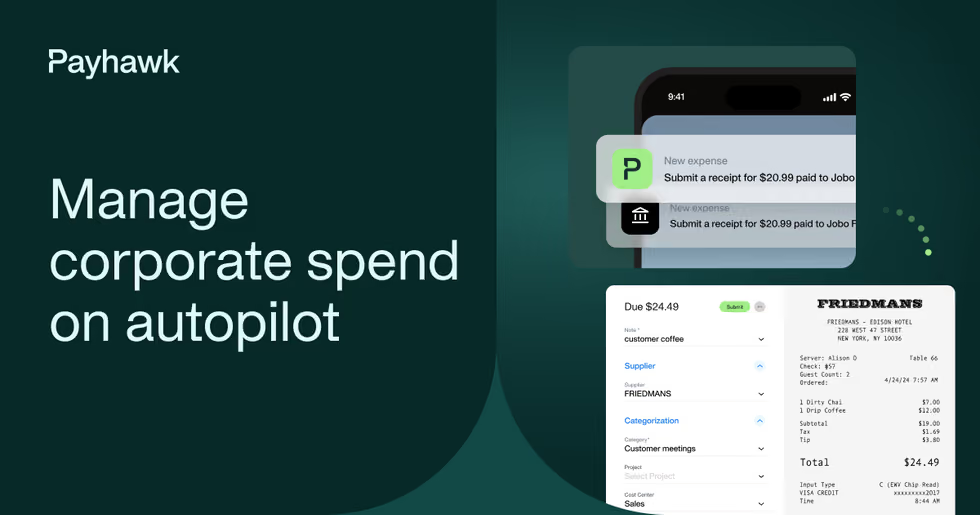
Cards & Expenses creates an expense the moment a card is used, chases the receipt on the phone and handles reimbursements. Its Link & Control feature also connects existing Visa, Mastercard and American Express cards, so a company can keep its bank card program and still use Payhawk for receipts, coding and spend rules.
Accounts Payable adds bill management, an approval workflow designer, vendor verification, scheduled and bulk payments, OCR and line-item splitting. Procurement adds purchase orders, 2-way and 3-way matching and discrepancy approvals by amount or percentage, the controls an audit committee asks about.
Travel covers hotel and flight booking under a custom travel policy, trip approvals and automated expense reports. Companies whose main question is travel should compare it with the picks in the corporate travel guide.
Five power-ups sit outside every module: the credit line, budget tracking, bidirectional ERP connectors for NetSuite, Business Central, Microsoft Finance and Sage Intacct, enterprise HRIS connectors such as Workday and ADP, and additional entities. A NetSuite shop should treat that connector as part of the price, not an option.
Payhawk key features
Payhawk pricing
Prices below were read on November 4, 2026 on Payhawk's US pricing page, Payhawk's US Visa card fee schedule, Ramp pricing, Brex pricing, Pleo's US pricing page and Navan pricing.
Each Payhawk module has a monthly floor, not a per-user rate. The page shows a "starting at" price per month for each of the four modules and no yearly toggle. Payhawk's own FAQ says the final price depends on the modules and add-ons chosen, the number of admin and accountant seats, the cards issued and transaction volume, so treat each figure as an entry point for a quote.
Our arithmetic on the published floors: Cards & Expenses alone is $5,388 for twelve months. Adding Accounts Payable brings the monthly floor to $798, or $9,576 a year. Buying all four modules separately starts at $1,596 a month, or $19,152 a year. Payhawk Complete, which also includes the AI agent package, has no printed price.
Headcount decides whether the floor is cheap. Pleo Build is $14 per user a month, so 32 users cost $448 a month and 33 cost $462; from that headcount up, the Cards & Expenses floor is the lower figure. Brex Premium at $12 per user crosses the same line at 38 users, and Navan Expense, free for five users and then billed per user, at 35.
Ramp Plus is $15 per user a month plus a platform fee based on team size that Ramp does not print, so 30 users already pass $449 before that fee. Ramp's free plan and Brex Essentials charge nothing per user, which no flat floor can beat for a domestic team.
Foreign card spend is the second cost to model. The US client fee schedule lists a 2.99% FX rate on Payhawk Visa card transactions in another currency. On $20,000 of such spend a month that is $598, against $350 on Pleo Build at its 1.75% card FX fee. Payhawk's corporate card page advertises 1.99% outside 26 no-FX countries, so the vendor's pages differ: ask which rate applies to a US-issued card before you sign.
The same schedule lists 2.99% (minimum $5) for ATM withdrawals, a $25 chargeback fee, $10 per physical card shipped by first-class mail, and a late payment fee of 4% a year above the Fed funds rate. Payhawk says it charges no implementation fee.
Travel is where the gap is widest: Navan Travel is free for companies up to 300 employees, funded by supplier commissions, while Payhawk's Travel module starts at $299 a month. The expense software pricing comparison lays out the wider field, and the Ramp pricing breakdown covers Ramp's platform fee.
| Plan | Price | Best for |
|---|---|---|
| Payhawk Travel | From $299/mo | Hotel and flight booking, custom travel policy, trip approvals, automated expense reports |
| Payhawk Accounts Payable | From $349/mo | Bill management, approval workflow designer, vendor verification, bulk payments, OCR |
| Payhawk Cards & Expenses | From $449/mo | Card linking, real-time expenses, receipt chasing, reimbursements, optional Payhawk Visa cards |
| Payhawk Procurement | From $499/mo | Purchase orders, purchase intake, 2-way and 3-way matching, discrepancy approvals |
| Payhawk Complete | Contact sales | All four modules plus Financial Controller, Travel, Procurement and Payments AI agents |
| Payhawk add-ons | Contact sales | Credit line, budget tracking, NetSuite or Sage Intacct connectors, enterprise HRIS, extra entities |
| Payhawk US Visa card FX rate | 2.99% | Card transactions in a currency other than the card's, per the US client fee schedule |
| Payhawk US Visa ATM withdrawal | 2.99%, min $5 | Domestic and international withdrawals; POS transactions carry no fee |
| Ramp Free | $0/user/mo | Unlimited cards, expenses, bill pay with OCR and travel booking, no subscription |
| Ramp Plus | $15/user/mo + platform fee | NetSuite and Sage Intacct integrations, multi-entity support, 30-day free trial |
| Brex Essentials | $0/user/mo | Global cards, up to two entities, local currency wires, travel booking |
| Brex Premium | $12/user/mo | Multiple expense policies, US and international multi-entity, ERP and HRIS integrations |
| Pleo Build, monthly billing | $14/user/mo | Prepaid cards, reimbursements, approvals; 3-user minimum |
| Pleo Optimise, monthly billing | $18/user/mo | Adds budgets, HRIS integrations and a 1.49% FX fee |
| Navan Expense | $15/user/mo after 5 free users | Expense software; Navan Travel is free up to 300 employees |
Payhawk pros and cons
What we like
- Every module includes unlimited employee seats, card transactions and document processing.
- Link & Control syncs existing Visa, Mastercard and Amex cards, so a bank card program can stay.
- No implementation fee, and 50+ HRIS integrations and SSO are included in every module.
What could be better
- Even the cheapest module is a high monthly floor for a small team with few cardholders.
- NetSuite, Sage Intacct and Business Central connectors, budgets and extra entities are paid add-ons.
- Its US Visa card lists a higher foreign-exchange rate than Pleo charges on Build.
Who Payhawk is for
Payhawk fits a company of roughly 50 to a few thousand employees with entities on both sides of the Atlantic, a controller who wants one approval engine for cards, bills and purchase orders, and enough cardholders that a flat module fee beats a per-user one.
It is the strongest fit for a European group adding a US entity, or a US company with UK and EU subsidiaries, because the cards are issued locally in each region and the integration list runs from QuickBooks Online and Xero to DATEV, Exact Online and SAP.
Skip it below about 30 spenders, where Pleo or a free card platform costs less. Skip it for a purely domestic company happy with one card, where Ramp and Brex include expense software free.
A company whose main spend is travel should read the Navan review first, and a team whose real problem is supplier invoices belongs in the AP automation guide. For purchase-order controls on their own, compare the procurement software guide.
Best Payhawk alternatives
If Payhawk is not the right fit, these are the closest options.
| Tool | Best for | Starts at | |
|---|---|---|---|
| Payhawk | Multi-entity companies in the US, UK and Europe that want cards, AP and procurement in one system. | Modules from $299/mo (Travel) to $499/mo (Procurement) | Visit → |
| Ramp | US companies that will run spend on one corporate card and want expense software at no subscription. | Free plan at $0/user | Visit → |
| Brex | Companies that want a free card and expense stack and may grow into international entities. | Essentials $0/user/mo | Visit → |
| Pleo | Smaller US teams with European roots that want prepaid cards and receipt capture billed per user. | Build $14/user/mo and Optimise $18/user/mo on monthly billing | Visit → |
| Navan | Companies under 300 employees whose largest spend line is business travel. | Travel free up to 300 employees | Visit → |


The bottom line
Payhawk is worth its price for a multi-entity company with dozens of cardholders, because the flat module fees stop growing with headcount and one approval engine covers cards, bills and purchase orders across US, UK and EU entities.
Get a quote for the modules you need plus the ERP connector, and ask two questions before signing: which add-ons your ERP and entity count require, and which FX rate applies to your US cards. Those two answers move the real cost more than the published floors do.
Choose Ramp or Brex when spend is domestic and one card program can carry expense software at no subscription. Choose Pleo for a small team billed per user, and Navan when travel is the main bill.
The Ramp vs Brex comparison settles the card-platform question, and the corporate cards guide ranks the wider card field.
This page is general information, not personalized financial advice. Confirm current fees, card terms, credit approval and eligibility with Payhawk and each provider before you sign.
Cite this: CFOpresso, "Payhawk Review 2026", November 2026.
Frequently asked questions
Is Payhawk a good spend management platform in 2026?
How much does Payhawk cost?
Does Payhawk charge per user?
What does Payhawk charge on foreign currency card spend?
How does Payhawk compare with Pleo?
Sources
Prices and plan details come from each vendor's own pricing page, re-checked by the Toolradar pricing tracker.
- Ramp pricingchecked Sep 2026
- Brex pricingchecked Sep 2026
- Navan pricingchecked Sep 2026
Some offers on this page may be paid placements or contain affiliate links.
More CFOpresso reviews
Buyer guides and software reviews, with prices read from each vendor's own pricing page.
Browse all reviews