
Navan Review
Navan bundles corporate travel, expense, and cards in one platform, free up to 300 employees. Built for finance teams that want travel and spend together.

Navan is one of the few travel and expense platforms that is genuinely free to start, and for companies under 300 employees that alone makes it worth a demo. You pay nothing for travel booking, and expense management is free for your first 5 monthly expensing users, then $15 per expensing user each month after that.
The biggest strength is having travel, expense, and corporate cards in one system instead of three. The biggest catch is that the deepest controls and negotiated rates live in the custom-quoted Enterprise tier, so the sticker price and the real price diverge as you scale. If Navan feels too travel-led, Ramp is the alternative most finance teams weigh against it.
Key factsBest for: Growing finance teams that want travel, expense, and…
- All-in-one corporate travel, expense, and card platform, free to start under 300 employees.
- Founded: 2015
- Headquarters: Palo Alto, California
- Free plan: Yes, up to 300 employees
- Alternatives covered: SAP Concur, Ramp, Brex, Expensify, Perk (formerly TravelPerk)
Pros
- Genuinely free to start: no travel booking fees and expense free for your first 5 monthly expensing users
- Travel, expense, and cards live in one system, so trips reconcile themselves instead of becoming reports
- Consumer-grade booking flow drives high employee adoption and in-policy bookings
Cons
- The deepest controls, negotiated rates, and full back-office features sit behind the custom-quoted Enterprise tier
- The built-in travel engine is wasted spend if your team rarely flies
- Fast-growing teams can outgrow the free plan mid-year and get pulled into a sales conversation
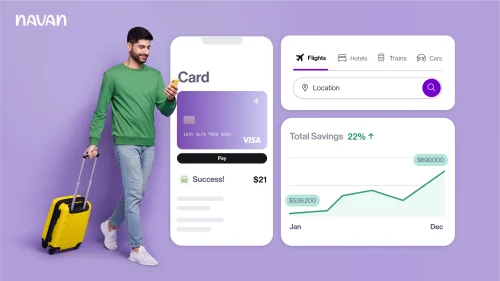
Corporate travel and expense used to mean stitching together a travel agency, a card program, and an expense tool that none of your employees liked. Navan, the company formerly known as TripActions, pitches itself as the single system that runs all three.
For a CFO or controller the real question is not whether the demo looks good, because every T&E demo looks good.
It is whether the free Business tier actually covers your team or quietly funnels you toward a custom Enterprise contract once you need real controls.
This review works through what Navan is, how it feels to run day to day, what the pricing really costs past the free headline, and who it fits.
I focus on the finance-team view: close speed, policy enforcement, card controls, and ERP sync, not just how pretty the booking screen is. Where Navan falls short I say so, and I name the competitors worth shortlisting alongside it so you are not comparing it only to itself.
What is Navan?
Navan is an all-in-one business travel and expense management platform built by TripActions, which rebranded to Navan in 2023. It combines three products that finance teams usually buy separately: Navan Travel for booking and managing corporate trips, Navan Expense for capturing and reconciling spend, and Navan corporate cards for payment.
The idea is that a flight booked in Navan Travel arrives in Navan Expense already coded and matched to its card transaction, so nobody files a report for it.
On the travel side you get a consumer-style booking tool with a large global inventory of flights, hotels, and cars, negotiated corporate rates, unlimited policy and approval workflows, 24/7 human travel support, and duty-of-care tracking of where travelers are.
Expense adds receipt scanning, AI categorization, out-of-policy flagging, automated reimbursements, and an AI assistant called Ava. If you already run Amex, Visa, or Mastercard cards, Navan Connect layers Navan's expense automation on top without forcing you to switch card programs.
It sits squarely in the mid-market and enterprise T&E category against SAP Concur and the newer spend platforms.
How Navan works
Setup starts with connecting your HRIS to sync employees and departments (Navan lists 30+ HRIS integrations), importing or issuing cards, and writing policies as rules: per-diem caps, fare classes, and approval chains by team or trip cost.
Once that is in place the day-to-day is light. An employee books a trip inside policy without approval, or gets a fast yes or no if they go over. The card charge and receipt auto-match, Ava suggests the category, and the expense closes itself.
For most trips the finance team touches nothing until the reconciliation stage. The interface is the strongest part. It feels like a consumer travel app, which is why adoption tends to be high and why employees actually book in-tool instead of going rogue on a public booking site.
Reporting and dashboards give real-time spend visibility, and ERP sync pushes coded transactions into your accounting system.
The rough edges: booking fees and change support can vary, and the free tier's control and back-office depth is thinner than Enterprise, so a fast-growing team can outgrow the free plan mid-year and land in a sales conversation sooner than expected.
Navan key features
Navan pricing
Navan has two tiers and the split matters. Navan Business is free for companies up to 300 employees. Travel costs nothing upfront because Navan earns from travel-provider commissions, and expense management is free for your first 5 monthly expensing users.
After that it is $15 per expensing user per month, and you are billed only for people who actually submit an expense in a given month, not every seat. At that price you get unlimited policy and approval workflows, 24/7 travel support, receipt scanning, connections for your existing corporate cards, and ERP integrations.
Navan Enterprise is custom-quoted and requires a demo, adding a dedicated account executive and CSM, custom implementation, corporate negotiated rates, and deeper back-office controls. There is no public number, and as a starting point, not a quote, buyers of comparable mid-market T&E platforms often negotiate to roughly $10 to $18 per active user per month.
Most teams pay far less than expected on Business, but the controls that justify Enterprise are exactly what growing finance teams eventually want.
| Plan | Price | Best for |
|---|---|---|
| Navan Business | Free (expense free for first 5 users, then $15/user/mo) | Companies up to 300 employees |
| Navan Enterprise | Custom quote (contact sales) | Large orgs, unlimited users, dedicated support |
Navan pros and cons
What we like
- Genuinely free to start: no travel booking fees and expense free for your first 5 monthly expensing users
- Travel, expense, and cards live in one system, so trips reconcile themselves instead of becoming reports
- Consumer-grade booking flow drives high employee adoption and in-policy bookings
What could be better
- The deepest controls, negotiated rates, and full back-office features sit behind the custom-quoted Enterprise tier
- The built-in travel engine is wasted spend if your team rarely flies
- Fast-growing teams can outgrow the free plan mid-year and get pulled into a sales conversation
Who Navan is for
Navan is a strong fit for growing companies with real business travel and a finance team that wants travel, cards, and expense in one system instead of three vendors.
If you are under 300 employees and travel regularly, the free Business tier is close to a no-brainer to trial, because the cost of trying it is essentially zero and adoption is usually high thanks to the consumer-grade booking flow.
It is a weaker fit if you barely travel. A software company where nobody flies is paying for a travel engine it will not use, and a pure expense-and-card tool will feel lighter.
In that case Ramp or Brex give you cards and expense automation with less travel overhead, and Expensify is cheaper still for expense-only needs. Very large global enterprises with entrenched Concur contracts and complex multi-entity accounting may also find Navan's Enterprise tier a real migration, not a quick swap, so weigh the switching cost against the adoption win.
Best Navan alternatives
If Navan is not the right fit, these are the closest options.
| Tool | Best for | Starts at | |
|---|---|---|---|
| Navan | Growing finance teams that want travel, expense, and corporate cards in one platform | Free up to 300 employees | Visit → |
| SAP Concur | Large enterprises needing deep, configurable T&E compliance and global coverage | Expense Base from $7/report and Plus from $11/report, unlimited users | Visit → |
| Ramp | Card-and-expense-led teams that want aggressive automation and cashback | Free core plan | Visit → |
| Brex | Startups and global scaleups wanting cards, expense, and banking together | Free Essentials plan | Visit → |
| Expensify | Small teams that just need cheap, simple expense reporting and receipt scanning | Free Submit plan for individuals | Visit → |
| Perk (formerly TravelPerk) | Travel-heavy teams wanting a dedicated booking platform with flexible cancellation | Starter has no subscription and a 5% booking fee (min $2, max $30) | Visit → |


The bottom line
Navan earns its shortlist spot because it is one of the only platforms that makes travel, expense, and corporate cards work as one system, and it is free to start under 300 employees. For a mid-market finance team with regular travel, that combination of low entry cost and high employee adoption is hard to beat, and it is the reason Navan keeps winning against the older T&E incumbents.
Pick something else when travel is not central to your spend.
Ramp is the sharper choice for card-and-expense-led teams that want automation and cashback, Brex suits startups and global entities, and Expensify wins on price for simple expense reporting. If you are a large enterprise already deep in SAP Concur, Navan is a real upgrade in usability but a genuine project to migrate. For most growing companies that actually send people on trips, Navan is worth the demo.
Frequently asked questions
How much does Navan cost?
Is Navan worth it for finance teams?
Does Navan have a free plan or free trial?
What are the best Navan alternatives?
Can Navan use our existing corporate cards?
Sources
Prices and plan details come from each vendor's own pricing page, re-checked by the Toolradar pricing tracker.
- Navan pricingchecked Sep 2026
- SAP Concur pricingchecked Sep 2026
- Ramp pricingchecked Sep 2026
- Brex pricingchecked Sep 2026
- Expensify pricingchecked Sep 2026
Some offers on this page may be paid placements or contain affiliate links.
More CFOpresso reviews
Buyer guides and software reviews, with prices read from each vendor's own pricing page.
Browse all reviews